actPrimitive action
Send one action. Stops any running macro or controller.
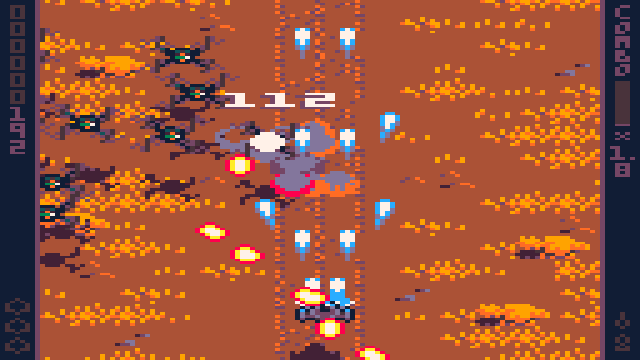
Praxis Fighter X / VISTA
At most one action per model call. The game keeps running.
def run(api):
 import numpy as np
 for i in range(240):
  o=api.observe(); a=o.rgb
  # Blue hull pixels near the bottom identify current horizontal position.
  m=(a[560:680,:,2]>100)&(a[560:680,:,0]<130)&(a[560:680,:,1]>70)
  yy,xx=np.where(m); x=float(np.median(xx)) if len(xx)>10 else 640
  # Bright magenta/red projectiles, excluding the side HUD.
  b=(a[:,:,0]>235)&(a[:,:,1]<115)&(a[:,:,2]>35)
  b[:300]=False; b[:, :100]=False; b[:,1180:]=False
  by,bx=np.where(b)
  near=(abs(bx-x)<150)&(by>390)
  if np.any(near):
   threat=float(np.mean(bx[near])); direction='ArrowRight' if threat<x else 'ArrowLeft'
  else:
   direction='ArrowRight' if (i//22)%2==0 else 'ArrowLeft'
  if x<220: direction='ArrowRight'
  if x>1060: direction='ArrowLeft'
  api.act({'action':'press_keys','keys':['x',direction],'duration':0.18})
 api.request_handoff('Short firing/dodging trial finished; inspect score and lives.')
Next action at 0:42.16 (4.12 s later).
A Visual Agent Harness for Real-Time Gameplay
The game runs during model calls. With AutoPILOT, a model-written controller reads the screen and acts between calls.
Original VISTA input alongside a re-enactment of recorded responses. Overlays estimate positions from pixels. Keys show requested inputs. AutoPILOT reached the target at 1:25.77 in the replay and 2:00.76 in the original run (wall time).
Multimodal foundation models can play video games well when the game waits for them, but often fail when it keeps running.
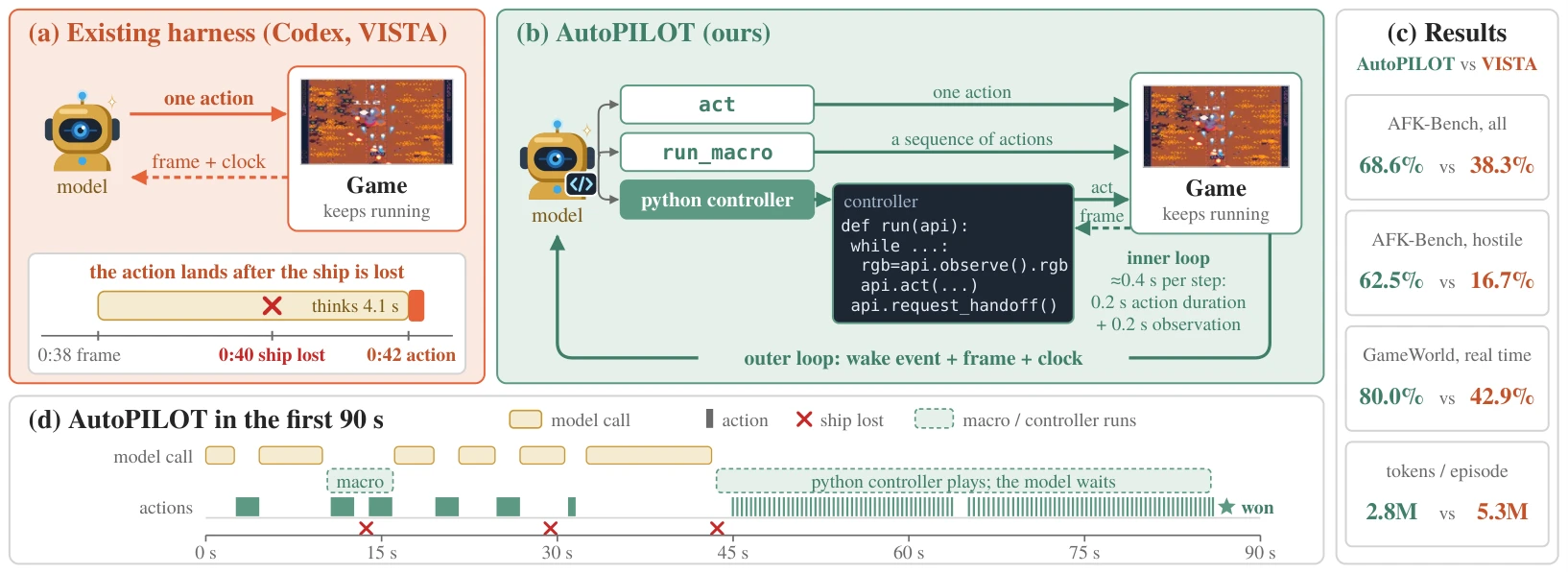
We find that much of this gap lies in the harness, which decides what the model sees, what it remembers, and how its outputs become actions over time. Existing harnesses such as VISTA improve the first two, yet turn each model call into at most one action, so the agent acts only as often as its model thinks. We introduce AutoPILOT, which changes the third: in each model call, the model can send a primitive action, start an open-loop macro, or write a closed-loop controller that keeps playing from the screen without further model calls until it hands control back.
To evaluate agents in real-time games, we build AFK-Bench, 120 diverse browser games grouped by how they respond to inaction and playable in real time or with the clock paused. With GPT-6.1 Sol under the same budgets, AutoPILOT reaches 68.6% real-time success against 38.3% for VISTA, and on GameWorld it keeps 80.0% in real time while VISTA drops from 84.1% to 42.9%. Its gains hold across closed and open-source models, and it reaches VISTA's final success rate at a fifth of its API cost. Our results suggest that how a harness turns model outputs into actions over time is a central yet underexplored part of agent design, and we hope AutoPILOT and AFK-Bench will serve as a foundation for agents in a world that does not wait.
With GPT-6.1 Sol at low effort, median model latency was 6.1 s. A controller step took 0.41 s at the median. The action itself took about half of it and the model decides its duration. The screenshot and state read that follow took the rest.
actSend one action. Stops any running macro or controller.
run_macroExecute a sequence of actions without reading the screen.
pythonRun model-written Python that reads frames, acts and can hand control back.
With GPT-6.1 Sol in real time, controllers send 98% of environment steps in hostile games and 89% in benign games. In turn-based games, where the model can plan ahead, open-loop macros account for 36% of tool calls and 26% of environment steps.
Removing controllers lowers hostile real-time success from 62.5% to 50.8%. Removing macros has its largest effect in turn-based games, where success falls from 83.3% to 78.3%.
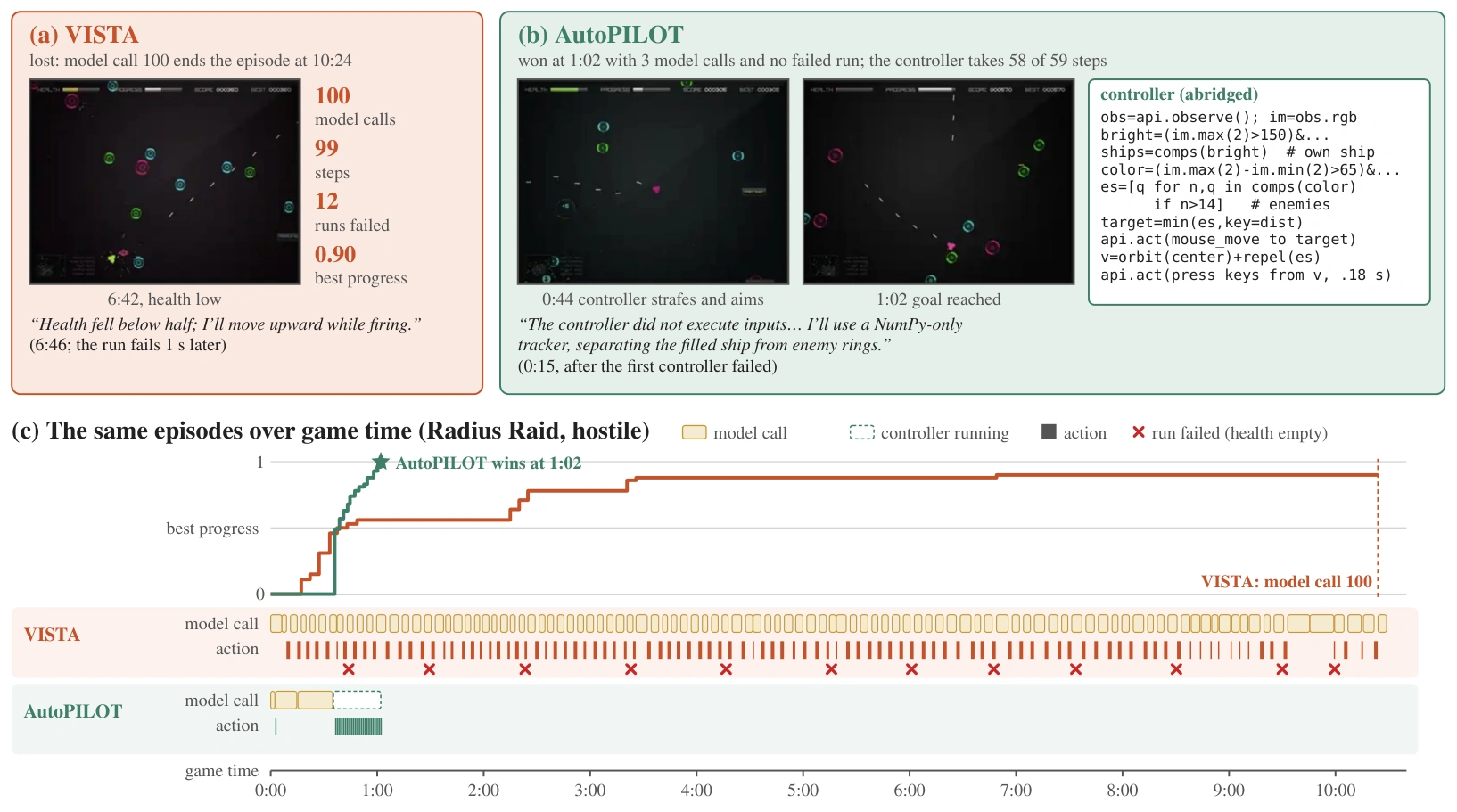
Radius Raid. The controller tracks enemies by color and takes 58 of 59 steps. AutoPILOT wins at 1:02 in three model calls.
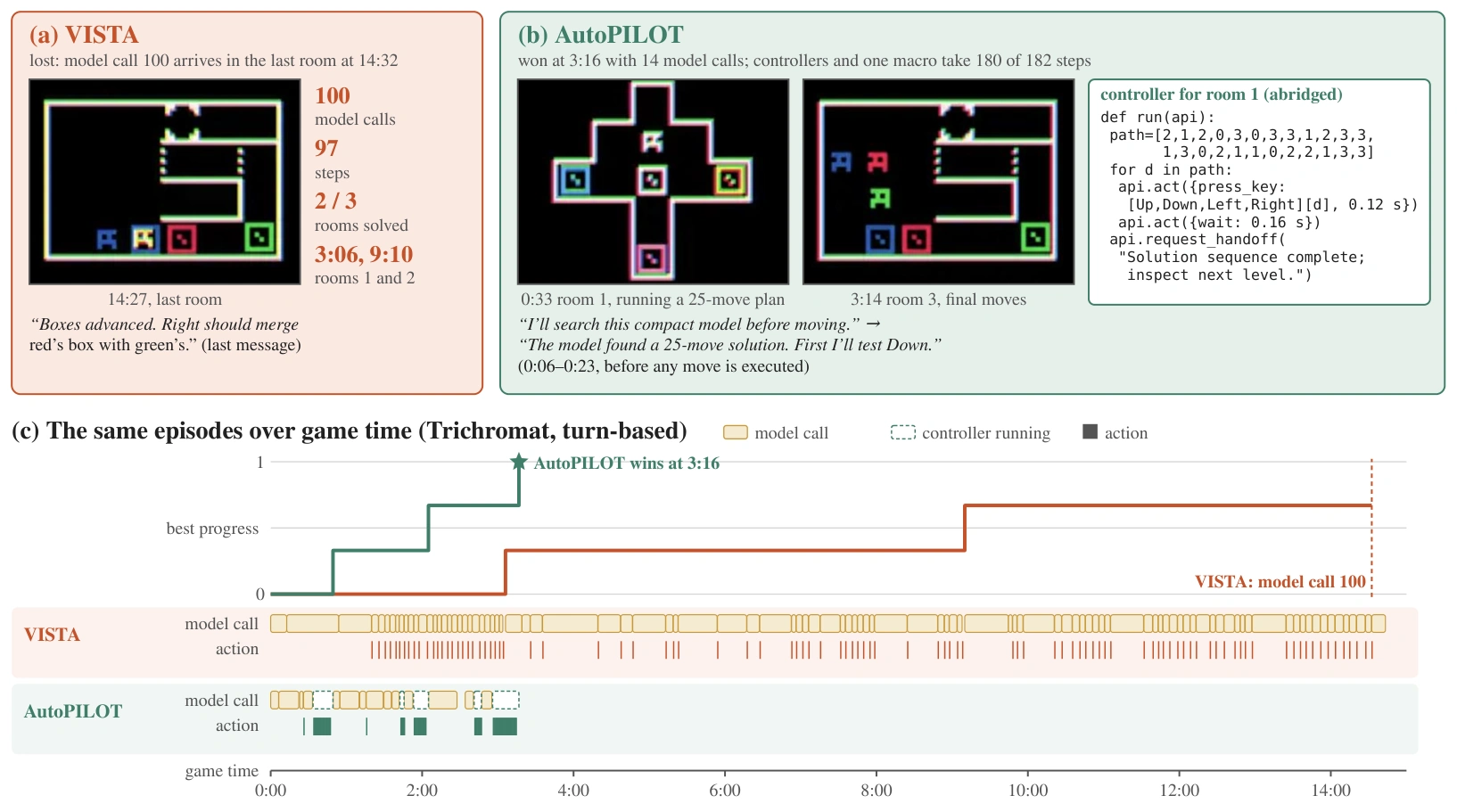
Trichromat. The model uses Python to plan moves. Controllers and one macro execute 180 of 182 steps. AutoPILOT clears all three rooms by 3:16 with 14 model calls.
With GPT-6.1 Sol, real-time success on AFK-Bench is 68.6% for AutoPILOT and 38.3% for VISTA.
Switching from a paused clock to real time lowers success by 4.5 percentage points for AutoPILOT and 17.8 for VISTA. Even with the clock paused, AutoPILOT leads by 17.0 points. A macro or controller can carry out many steps per model call.
120 games · 40 per environment type
| Rank | Model / Effort | Harness |
|---|
Each episode allows 100 model calls, 2,000 environment steps and 2,000 seconds of game time. GPT-6.1 Sol ran three episodes per game, other models one. GPT-6 Astra and Claude Fable 5.2 were evaluated with AutoPILOT in real time at low and high effort.
AutoPILOT with GPT-6.1 Sol solves 80.0% of 170 tasks in real time across 34 games.
| Model | Harness | Paused | Real time | Paused − Real time Smaller is better |
|---|---|---|---|---|
| GPT-6.1 Sol | AutoPILOT | 82.9% | 80.0% | 2.9 pp |
| GPT-6.1 Sol | VISTA | 84.1% | 42.9% | 41.2 pp |
| Claude Opus 5.5 | AutoPILOT | 72.4% | 67.6% | 4.8 pp |
| Claude Opus 5.5 | VISTA | 67.1% | 41.2% | 25.9 pp |
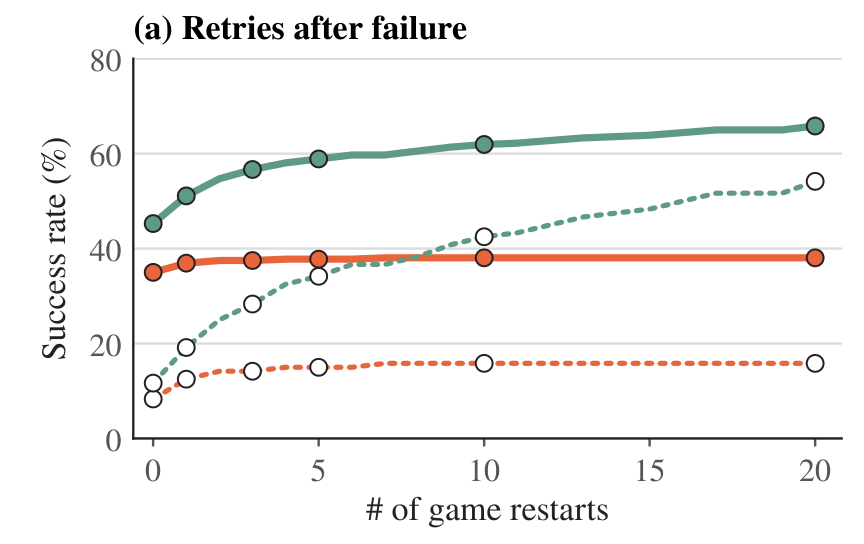
On hostile real-time games, GPT-6.1 Sol wins on the first attempt in 11.7% of episodes with AutoPILOT and 8.3% with VISTA. Within 20 restarts, success reaches 54.2% and 15.8%, respectively.
A life lasts about as long under both harnesses, but costs a median of two model calls with AutoPILOT and eight with VISTA. That leaves AutoPILOT more calls to retry. Among the 123 paired episodes in which both harnesses restarted, AutoPILOT won 71 and VISTA won seven.
In the main real-time runs, AutoPILOT averaged 681 environment steps from 43 model calls with GPT-6.1 Sol. VISTA averaged 78 steps per episode. It exhausted its 100 calls in 208 of its 222 failed episodes.
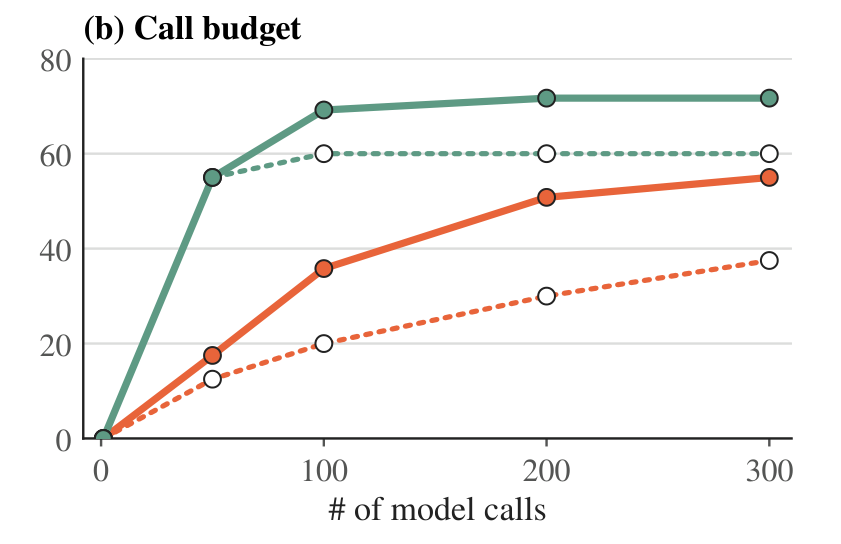
The budget experiment used one episode per game. Raising the limit from 100 to 300 calls lifted VISTA from 37.5% to 55.0% success. AutoPILOT went from 69.2% to 71.7%. In the 300-call runs, AutoPILOT had already reached 55.0% within 50 calls.
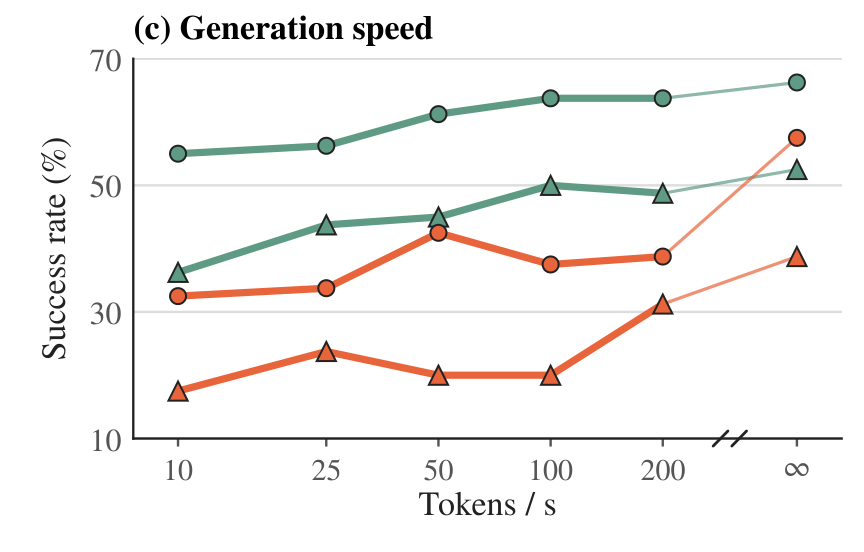
On the 80 hostile and benign real-time tasks, GPT-6.1 Sol at low effort reached 55.0% at 10 tokens/s with AutoPILOT and 63.8% at 200 tokens/s. VISTA reached 38.8% at 200 tokens/s and 57.5% with the clock paused.
The experiment simulates decoding speed by advancing the game clock according to the number of output tokens. Slower generation delays the start of a controller. Once running, the controller reads frames and acts at its own pace.
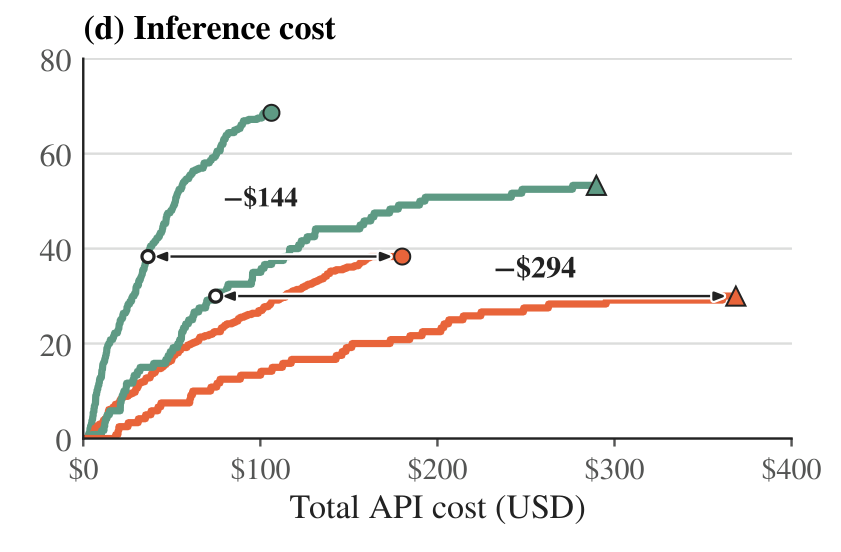
With GPT-6.1 Sol, AutoPILOT first matched VISTA’s final success rate at a total list-price API cost of $37. VISTA spent $180. With Claude Opus 5.5, the corresponding totals were $75 and $369.
The curve raises the spending cap per episode and sums costs across all 120 tasks. The white ring marks where AutoPILOT first reaches VISTA’s final success rate. Each arrow spans the difference in total spending at that success rate.
120 games grouped by the cost of inaction. Each group has 40 games, with one task per game.
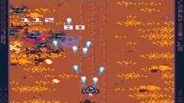
Standing still can cost health, a life or the attempt.
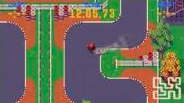
The world keeps moving while an idle player remains safe.
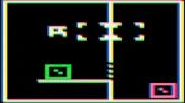
The world advances only when the player acts.
Wins with the clock running, out of three GPT-6.1 Sol episodes per game.
| Game | Environment | VISTA wins | AutoPILOT wins |
|---|
@misc{zhao2026autopilotvisualagentharness,
  title = {{AutoPILOT}: A Visual Agent Harness for Real-Time Gameplay},
  author = {Mark Zhao and Pengcheng Wang and Rui Yang and Jiarui Yao and Xirui Jiang and Yuxi Chen and Bingxuan Li and Hanyang Chen and Ke Yang and Manling Li and Tong Zhang and Huan Zhang},
  year = {2026},
  eprint = {2611.28202},
  archivePrefix = {arXiv},
  primaryClass = {cs.AI},
  url = {https://arxiv.org/abs/2611.28202}
}